
In January 2022, I joined the new ambient techno label npm as a voluntary writer. This label boasts a range of thrilling artists in the scene such as Giulio Aldinucci, Nocow and John Beltran.
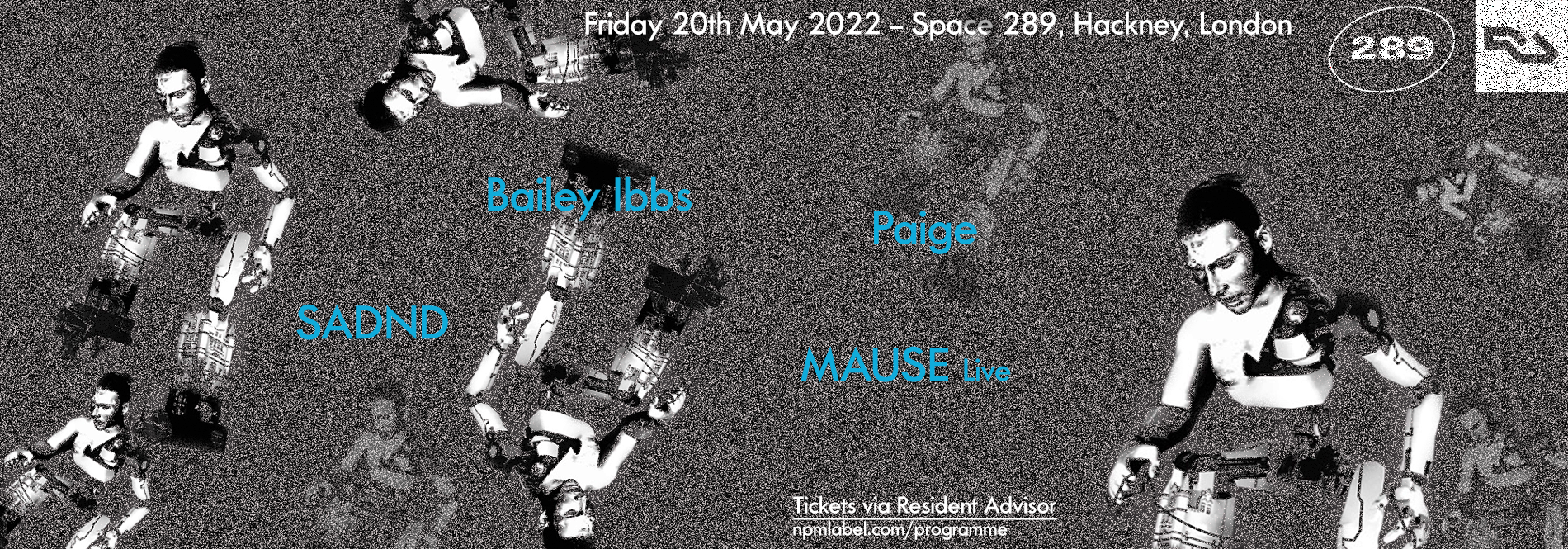
I have assisted with writing album previews as well as live event management. Most recently, npm’s first event at Space 289. Recently, I interviewed Luke Hess, DAMIE and Nocow; you can read these interviews below.
Nocow [30/9/22]
Before we explore your newest release ‘Magnit’, I’d like to delve into your musical persona a little bit. As an artist, your style of techno tends to drift between emotions; take the gentler rhythms of ‘Atoner’ compared with the more frantic melodies of ‘Youth’ for example. Do you find it important to produce a varied sound?
It often happens that I can plan one thing, but the opposite comes out. I can try to set a direction or a mood, but usually the music goes its own way; I just follow it. Of course, I can purposefully make some kind of track, but in most cases I just sit down at the computer and whatever comes out, I let it be. I listen to and love different music, so why should it not be like that in creativity?
You often incorporate dream-like vocals in your dense mixes too. Do you feel that this adds to the utopian atmosphere you are trying to create?
I can’t say that I’m doing it with some kind of calculation. I do as I feel, as my emotions and experiences lead me. I like to combine contrasting things, like hard beats and gentle vocals or dreamy/other-worldly melodies. This expands the spectrum of perception. I basically try to think less and feel more when I make music. For me, the most important thing
in art is emotions and I am pretty sure that the potential is hidden in the field of the unconscious.
Now, onto your new EP. ‘Magnit’, released on npm’s sister label p-ertönen, is an often-dark project that blends fast-paced percussion, ominous bass, and comatose synth. What was the timescale of this project? Had it been in the making for a long period of time, or did it feel like a spontaneous rush of creativity?
I usually make tracks in batches of 5-10 songs in a short amount of time. That is, after a pause, I can make several tracks in a row and, of course, they will have something in common that binds them. Although, I must note that there is a certain time interval between tracks from the EP, if I’m not mistaken those tunes were made in the last year or two.
I was instantly entranced by the closing track, ‘Extasy’, upon my first listen. It seemed sparser, like a cooldown from the furious beats prior. Could you give us an insight into the intention of this track?
I think that this track is one of my signature songs. Tunes like ‘Extasy’, ‘Forgiven’, ‘Alone’, I call “Cloud Techno“. It probably more accurately expresses my creative mood. Although I make different music, still, melancholy takes up a large part of my work. The theme of love and loneliness is quite widely expressed in my music. Which, of course, does not negate other moods. I also love ghetto vibes in some of my tracks, either IDM/experimental or even hip-hop and avant-pop tunes I do make a lot as well. But, as I said above, the emotional component in my case most deeply expresses my own style, I’d even admit.
With music production and live performance becoming more accessible with open-source software and the rise of ‘Laptop Music’, do you feel the industry is becoming more open to new talent?
Of course, the opportunities that have opened up thanks to technology, in truth, have no limits. Today literally every person who has an interest in creating music can turn into a professional producer by purchasing an iPad. This unequivocally opens up new talents to the world, sometimes in the most unexpected and bizarre forms. It is important to understand that one can easily get lost in the variety of possibilities, therefore, it is essential to find your own toolkit. This is best done in conditions of limited opportunities. But everyone should set their own limits. Because there are those who like to synthesize sounds by working with modular synthesizers, and for some, an iPad is enough. The good news is that the choice is truly enormous today.
While listening to your music, I find it almost intuitive to picture some form of dystopian, or dark urban landscape. The connection between atmosphere and rhythm is instant. Would you see your music being used in some form of visual production like TV or film, and if so, is there any pre-existing content in mind?
If the music creates images, that’s a good sign. In this release, the atmosphere is really more urban, although, I repeat, this is only one side of my work. In terms of soundtracks or sound design, I have had some experience and I’m certainly interested in finding a use for my music in that area as well. There are no specific preferences, I am always open to new things.
At the recent Present Perfect Festival, your performance was paired with a large group of emotive dancers and intimate lighting. Do you feel that live performances and their holistic involvement of the senses captures the sentiment of your music more than a studio recording?
It was the first time I had such an experience. I must say that it definitely reveals the potential of music in a different light. At least it opens up new facets of perception. The participation of other people in the performance complements something, enhances something, changes something. From a simple layer, a kaleidoscope can be born, or the opposite. This was a very interesting experiment, I myself heard my music differently, from a different angle.
Finally, I’m sure we will continue to see countless releases from Nocow, but what do you have in store for the future as an artist?
We’ve finished work on my debut vocal album on GOST ZVUK. This is a very voluminous project, in which, I think I expressed myself quite strongly. For the first time there are a lot of features with very talented musicians, thanks to whom the album has a special meaning for me. Serious work is being done and definitely it’s a new step. Can’t wait to get it released. No exact date yet, but hopefully soon.
Damie [20/6/22]
First of all, I’d like to congratulate you on your Berghain debut! How did it feel to play in a space with such history?
It was my honour to make a debut at Berghain stage after my debut at Panorama Bar in February 2018. I would like to express my incomparable gratitude to Berghain, Faust and the Ameniia Label family for trusting me. Also, to my lovely friends who came a long way to support my debut, I felt so comfortable and happy. To be honest, I was bothering people around me the night before the show as I was both excited and nervous.
Having seen your performance at Boiler Room, it’s clear you thrive off the interaction with the audience. How important is the community aspect of your live sets to you?
I feel completely wrong if the audience is not enjoying your set, even if the track itself is a great tune. Sometimes, I enjoy festivals or bigger stages, but always prefer intimate stages where you can laugh, smile, and even hug. As you can see from my social media, I have few photos or videos of my gigs because it is hard to capture the moment. There are many occasions where you can only do things if you are close to the audience. Equally, DJs are only human, so we cannot be 100% perfect in our technical skills on the floor, but this imperfection is always embraced by an audience. It is all in my hand whether I can make the audience dance or not.
Do you think that following the pandemic-induced hiatus in clubbing, the culture has changed at all? Or is it more alive than ever?
I could really see there are many ravers who left the field, but at the same time young, new ravers have appeared. Due to the sudden gap of ravers, it can be a bit tricky to harmonize both experienced and non-experienced ravers, like for example, how to respect the floor and manners. Our culture remains as it is, but it sometimes needs guidance towards a better direction. Also, due to the pandemic period, there are clear differences in musical tastes, but all of them are more alive than ever.
In many of your mixes, you create an invigorating blend of hard techno grooves with an often more reserved textural synth. How did you discover the DAMIE sound?
I prefer dragging groove with deeper, darker, or heavier techno sounds, but I also add emotional melody or dramatic synthesis sounds when tracks, or moments within tracks, have simple beats. In this way, I can sketch out my set like a documentary or movie scene with loving imagery, waves, and wind while playing.
Your new track ‘Golden Rule’ as part of FAUST’s compilation record is a perfect example of this minimal type of sound. Is this forensic level of detailed sound design fundamental to your production process?
Yes, exactly – you caught on. I would rather use simple or minimal sound elements to create a maximalist outcome. Some may say there are lack of frequencies, but this is also a part of the track, I believe.
What, in your view, drives South Korea to be the thriving techno scene it is today?
Leading venues like FAUST have worked so hard for more than 8 years in the Korea techno scene, standing still with a solid mind and attitude. I really respect what they have achieved through opening doors to our local artists. Raves, great international artists, and local artists work as a powerful trinity.
And finally, what does the future have in store for DAMIE?
I have an upcoming festival gig in Mongolia where I can be in the nature alongside artists and good friends Boris, Anetha and Marcus L. Additionally, there may be a new EP in 2022. 😉
Luke Hess [11/5/22]
First off, I’d like to talk about your signature sound. You evidently pay attention to the finer details of classic Detroit tropes, but are there any other genres you take inspiration from?
Beyond the obvious and vast Detroit techno inspirations & the never ending genres of electronic music in general – I’ve listened to a lot of dub reggae, instrumental hip-hop, jazz, trip hop, psychedelic rock, classical, ambient music, & just simple emersion in the sounds of nature. Lately, I seem to find more inspiration from these other genres of music, mixing styles, engineering techniques, and just experimenting with analog gear & trying to create fresh sounds than I do listening to strictly techno or dance oriented music.
I’m also really curious about your inclusion of field recordings embedded in your tracks. Whether it’s distant chirps or flowing rivers, it adds a subtle human element. Does nature regularly play into your music production process?
Several years ago I spent quite a bit of time with my field recorder. I would complete long recordings in various settings for underlying noise in the background of my music, and spent a lot of time recording various sounds that could be cut up & use as percussion. I recently purchased a simple Zoom H6 & plan to get back to this process again while writing my 3rd album. There is no substitute for God’s musical creation!
In the ongoing debate between using hardware or software in production, do you think there will ever be a favourable method? Or is it down to the creator themselves?
There are many producers who are heavily trained in software only & make incredible music. Personally, I need all the time I can get away from screens. I use software for sequencing, mixing, & engineering. But I need to get my hands on equipment to bring my sound ideas to life. The longer I make music, the further away I want to get from software all together. From my experience (and maybe because I never spent enough time with VSTs) I just seem to get a thicker, richer, warmer, & rawer sound using analog gear. When experimenting with various VSTs I seem to spend way more time trying to shape & mold sounds than necessary, and often times software just seems to sound thin. There just seems to be more character, human interaction, & perfect imperfections while using analog gear – and this is the process I enjoy while crafting sounds.
You’re a regular collaborator, both in live sets and studio releases with the likes of Omar S, Patrick Russell and, more recently, Simoncino. Does this cooperation allow you to approach your own process differently?
Collaborations are a huge inspiration for me. They expand my sound palette and understanding of music creation & production techniques. Also, sometimes it’s a nice break to spend time with friends in the studio and share creative moments – knowing that soon other people will somehow share in this moment on a dancefloor. There is a time for solo production & a time for collaborations – I think a balance can be healthy for every artist.
After a swift Instagram browse, I can see you’ll be setting Detroit ablaze again in the TV Lounge very soon. How does it feel to perform like this once more, as restrictions begin to ease?
Yes – January 28th is a DeepLabs party at TV Lounge with Thor, Delano Smith, Norm Talley, my brother Jeff Hess (who will be performing his first all analog & modular LIVE PA), & myself. Everyone involved is super excited to start sharing music and getting involved with the community again. It’s essential.
Despite live shows returning, do you think the pandemic has introduced live streaming as a means of performance for artists including yourself?
In my personal opinion, Streaming is no substitute for a personal community experience. However, streaming does have many benefits & will continue to grow as a platform for artists, instruction, creation, & inspiration. Streaming definitely has its place to help expose artistic talent, but in my opinion it should not be the focus over physical interactions or hard work in the studio.
And finally, in your view, what are the main things that fuel the Detroit underground scene and make it the thriving culture it is today?
I believe in hard work, community interaction, mutual respect, support & mentorship. Understanding the history of the music & having a zeal for the future of underground music is key. Underground in my opinion is still where the best music is created & shared. Underground is an escape from the main stream, where money, fame, & pride can‘t destroy creativity & a where there is genuine pursuit for something beautiful, pure, and new. Detroit has a very strong musical & artistic community. In my opinion it’s the best place to live if you love music!
 lewis xavier dobbs